English Literature

Here is a subject that can through the magic of words make us happy, make us sad, provoke us to think about deep issues or simply keep us amused or intrigued. It is to be introduced to prose, poetry and drama. Students will be familiarised with many different styles and they will learn to understand how literary conventions of various periods have influenced writing. For example, the initially demanding (but ultimately rewarding!) tragic treatment of passionate relationships in Brontë’s ‘Jane Eyre’ can open young minds to the attitudes to marriage and social status which prevailed in the nineteenth century. A lighter look at the same territory will be encountered in Jane Austen’s ever-popular ‘Pride and Prejudice’. Hollywood's constant reworking of such literary scenarios indicates just how relevant these attitudes still are and often how effective humour can be as a vehicle for criticism. Just the same issues surface in the sultry and tense atmosphere of Tennessee Williams' play A Streetcar Named Desire set in mid-century New Orleans.  Poetry, that most specialized and refined of literary genres, will be central to the course which features an anthology of poetry by Irish poet W B Yeats, most famous of course for ‘Easter 1916’. William Shakespeare, voted the greatest figure of the Millennium, naturally finds his place in our studies. Students will become acquainted with one of his most powerful portrayals of love, jealousy and conflict: ‘Antony and Cleopatra’. With a completely new specification for our syllabus from 2008 and a new suite of texts for 2011 onwards, assessment by coursework will be a significant feature in each year of the course, with opportunities for close textual study and more extended comparative essays.

How English is taught at Hurtwood

English Literature continues to be one of the most popular subjects studied at A-level. At Hurtwood House some 100 students study English and the popularity of the subject, coupled with the lively and innovative approaches of the Department, is reflected in results that are consistently outstanding.
 
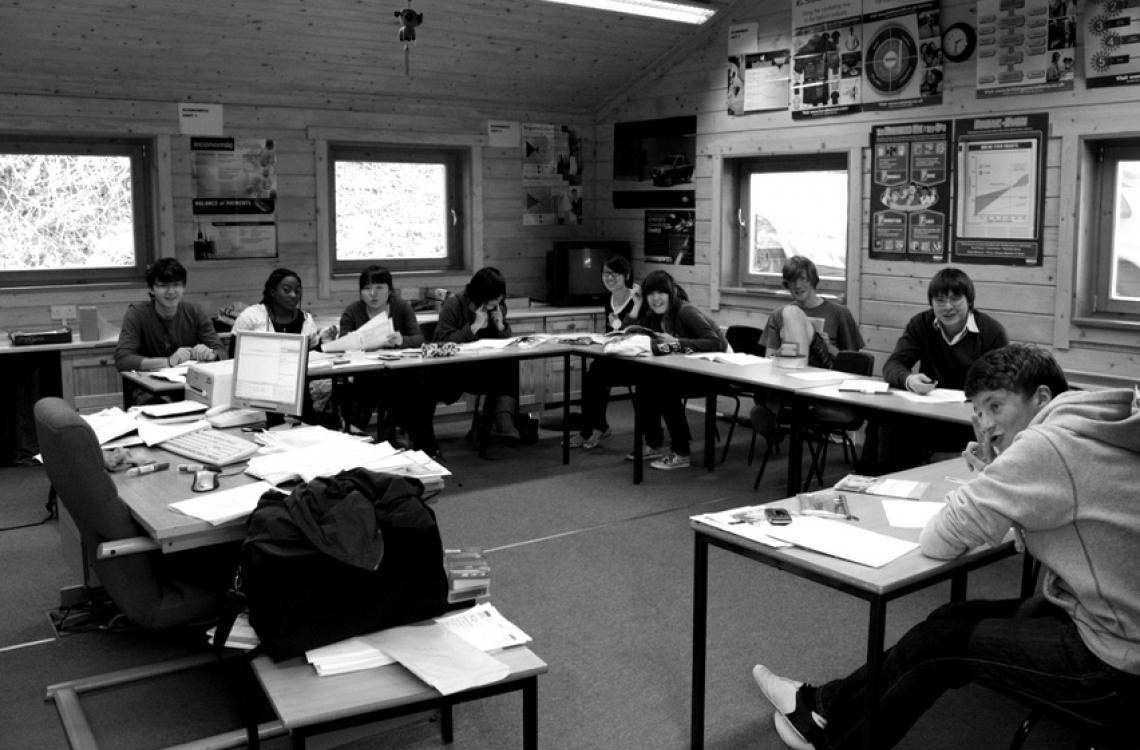
At Hurtwood House we see the teaching of English as much more than a mere transfer of information from teacher to students. The department involves students ‘head and heart’ in what they are studying, regarding English as a highly interactive subject. Here, responses to texts are not dreary re-formulations of the views of others. Not for us the passive approach! Your developing views, your unique learning curve over a range of literary awareness are what we want. You may be fortunate to have a grounding already in study skills. However, for the many students who come to us shaky about how to write essays, how to revise, or how to note texts efficiently, sustained help and practice is ever at hand. Many students find mind-maps helpful, for example in essay planning and revision and you'll find that at Hurtwood teachers make use of them for board work and group tasks in the classroom.
 
To return to that core skill of essay-writing, we do have exacting standards as far as the formalities of good English are concerned. Though our specification does not include ‘creative writing’ as such, we have a keen interest in what is going on in your creative imagination and enjoy reading your poems, stories and plays. Occasional competitions produce some terrific results, often surprising even their authors!

Hurtwood and beyond

When you leave Hurtwood you will be well informed about literary quality, confident about your own personal responses and preferences and assured about your capacity to express them verbally and on paper. All students leave with a fund of rich memories about their English classes: detailed engagements with fine literature, the cut-and-thrust of differing opinions, group fun and group groans (‘not another timed essay!’), all facilitated by teachers who know their job inside out and are open-minded on updating teaching methods. A review of your teachers’ term reports, accumulated over your English course will underline just how much they perceived about you - your strengths, weaknesses and (crucially) your potential.
 
We don't go in for ‘streaming’ in English. Our classes work best on a mixed-ability basis because of our good teacher/student ratio and our philosophy that personal response to literature is unique to each reader. Every member of an English class at Hurtwood House, including the teacher, has his or her perspectives widened by the views of others. Where marked aptitude for the subject has become apparent in some students, they are invited to take part in a weekly ‘Special English’ group - something of a fast-track for reading and discussion of literary extracts beyond the set texts. This is a popular option, as very able students appreciate being ‘stretched’. This forum is not shut to newcomers should a student's progress and motivation indicate it would be suitable.

The classroom’s not always inside

The English department's stress on participation involves a full programme. Characteristically, the outings, such as the visit to The Globe, the annual long weekend trip to Shakespeare country, visiting speakers, Shakespeare workshops and other theatre visits you will see on the calendar are augmented by un-calendared "happenings". Pizza-and-pint poetry recital evenings are always popular and over-subscribed. Other events tend to be arranged spontaneously according to what is going on locally.

The Specification

A/S

Unit 1: Prose and Poetry 1800-1945 (2 hours)
Selected Poetry – W B Yeats

Jane Eyre – Charlotte Brontë

[You may not take your annotated texts into the examination for this unit]


Unit 2: Post 1900 Literature (Coursework)
A Streetcar Named Desire – Tennessee Williams (close study)

A pair of texts chosen by the class teacher (comparative study)


A 2

Unit 3: Drama and Poetry pre-1800 (2 hours) for 2012 only:

Othello – William Shakespeare

The Duchess of Malfi – John Webster

The Pardoner’s Tale – Geoffrey Chaucer (or) Selected Poetry – John Donne


Unit 4: Texts in Time (Coursework)

An extended essay on three related texts chosen by the class teacher (comparative study)

What skills do I need?

English at Hurtwood House is described as ‘traditional, progressive and fun, with students under no illusions about what is expected of them’. If you are not already reading widely, you will be a person who wants to do so and you will find reading a pleasure, not a chore. Your tutors will be on hand to recommend authors and titles beyond your set texts. You will also be expected to write regular essays on your set books. You will be willing to persevere in your style and technique and work cooperatively with your teacher, in responding positively in the next assignment to advice given in marked work. Writing well is a core skill in English. We realise that the jump from GCSE standard to Advanced Level is a big one, so we give careful attention to supporting your development in essay-writing.

After A-level

English Literature is one of the most popular A-level subjects nationally. It goes well with Arts and Social Science subjects and is highly regarded by Admissions Tutors as a mainstream academic qualification. For Higher Education it is suitable for a wide range of degree courses in the Humanities, including English, American Studies, European Studies and Philosophy. As a communication subject it is also valued for Social Sciences and Business courses and it can be an asset to combine it with Theatre Studies at A-level if you are considering a general Humanities or Arts course at university. It is possible to combine English with Science subjects at A-level but, if this is the case, it is important to consider your Higher Education plans. Bear in mind that if you are considering reading English at university you will need to gain an A or a B pass in it at A-level. Do also be aware that the admittedly very tempting combination of English with both Theatre Studies and Media Studies will inevitably narrow down your options if you are intending to go on to university – such is the perception of Admissions Tutors.


RESUME OF SET TEXTS

AS
A Streetcar Named Desire - Tennessee Williams
W B Yeats - Selected Poetry
Jane Eyre – Charlotte Brontë
Class-specific texts for comparison.


A2
Othello – Shakespeare

The Duchess of Malfi - Webster

The Pardoner’s Tale – Chaucer (or) Selected Poetry – John Donne

Class-specific texts for comparison

Suggested Reading

The best practical advice if you are considering English as one of your AS level subjects is to get into the habit of browsing through a quality newspaper daily, lingering on items of interest. The Book Sections of ‘The Times’, ‘The Independent’, ‘The Observer’ and ‘The Guardian’ are all especially valuable resources. Do listen to Radio 4 programmes occasionally, like ‘Kaleidoscope’ and ‘Poetry Please’. PLEASE CLICK HERE FOR A SUGGESTED READING LIST

Extra English Group Work

Aims of the class:

’Extra English’ classes constitute one slot each week over three terms. The course will not generate any additional written work. However, it will require some extra reading by way of preparation for each weekly class. The format of the class will be informed and informative open group discussion, which we hope will be lively and stimulating.
 
In the past this course has proved invaluable in extending response to the set A-level texts, enhancing the sense of literary chronology as well as raising some of the key controversial issues in contemporary literary study. The classes should also prove valuable in aiding decisions on university courses and subsequently in conducting interviews. We intend the course to be flexible and adaptable but hope over the next few terms to cover the following
areas:
Early twentieth century literature: the rise of ‘Modernism’
DH Lawrence – extracts from ‘The Rainbow’ and the short stories
James Joyce – extracts from his novels ‘A Portrait of the Artist as a Young Man’, ‘Ulysses’ and ‘Dubliners’
TS Eliot – in particular ‘The Waste Land’ and ‘The Hollow Men’
A consideration of Joseph Conrad’s novella ‘Heart of Darkness
A chronological sweep of literary backgrounds – brief considerations of the following:
Chaucer - some extracts from ‘The Canterbury Tales’
Extracts from ‘Sir Gawain and the Green Knight’, extracts from Christopher Marlowe’s play ‘Doctor Faustus’ and a brief look at his poetry
A consideration of seventeenth century drama
Extracts from Milton’s ‘Paradise Lost’
Extracts from Johnson’s 'Rasselas’ and a consideration of the ‘Age of Reason’
A consideration of the rise of the novel
Various romantic poets: Wordsworth, Keats etc and a consideration of Romanticism v Classicism
Consideration of various issues in writing and reading: empathy, gender (can you sex a sentence?), deconstruction

Students selected are considered to be strong candidates in the subject who could benefit from the extra stimulus of contact with others in the pursuit of wider literary horizons.

Past Student Case Study - Louise Reid

When I was at Hurtwood I studied English, History, Theatre and Media.
 All of my classes were full of lively class discussions and made
 generally dull elements into something fun. I enjoyed classes at
 Hurtwood and so I found it easy and enjoyable to learn from all the
 teachers; I think this is a major reason why I did well in my final 3
 A-Levels: I left with 3 A grades and got into my first choice of
 university with a scholarship.
 
Hurtwood was two of the best years of my life and I have stayed in
 contact with so many people I met there. The school is quite small so
 everyone knows each other and because when you arrive on the first day
 everyone else is new too, it was so easy to make many strong, lasting
 friendships. Something I found a bit of a culture shock coming from
 quite a strict, oppressive secondary school was that the teachers at
 Hurtwood were so easy to talk to, took the time to get to know you and
 seemed to enjoy being there too. I know many of my friends will agree
 with me when I say that I found the media dept in particular to be a
 highlight of my time at Hurtwood as the teachers were so friendly and
 really good fun. When you were filming a project it was so hands on and
 professional; one of the projects I worked on won a Young People's Film
 Award.
 
Hurtwood definitely gave me the skills I needed to
 succeed in life and the confidence to try new things and to not be
 scared by the unknown. I think it gives you a sense of independence long
 before any other school would, even though you are still in a safe
 environment.
 
My one regret about Hurtwood was not going on the history trip to
 Russia, I SO wish I had gone now. The other day I met up with a few of
 my friends who went on it and they are STILL talking about it nearly
 four years later!

Hurtwood provides excellent education in a positive living and learning environment

Marion SimÃce
Past student