Maths

Mathematics is the oldest of the sciences and those who choose to study it as an A-level subject like its challenge, its clarity and its ability as a subject to reduce many different, apparently complex problems into the mathematical formulations of similar form from which analytical solutions can be obtained. Mathematics is all about logical analysis, deduction and calculation and its great importance lies in the fact that it can take the patterns it finds and use them to explain and control natural happenings and situations. In everyday, practical lives mathematics is indispensible.

How Mathematics is taught at Hurtwood

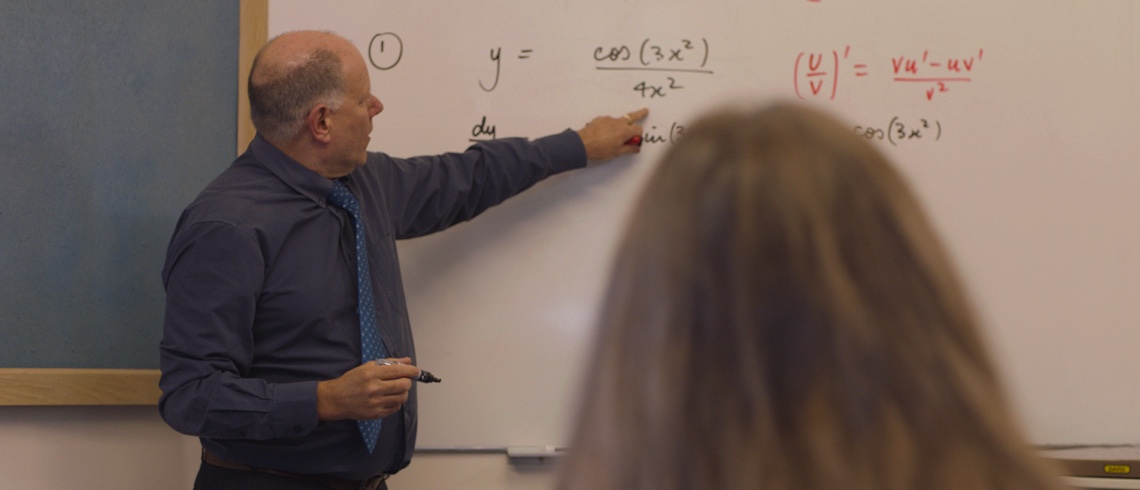
At Hurtwood House, Mathematics is a large, lively and outstandingly successful department. The teaching staff here ensure that not only do their students acquire the most important skill in the subject – that is, the ability to solve problems quickly, accurately and efficiently – but they also teach them why Mathematics is such a prestigious subject and the enormous range of its practical applications. At Hurtwood you will also learn that Maths is a structure of ideas which has a fascination and beauty of its own, and that it is also a means of understanding phenomena in the outside world, both in the physical sciences and in all areas of social, industrial, biological and economic activity.

It all adds up

It’s the teaching approach of the Maths Department at Hurtwood that marks it out as something special. Not only are all our tutors dedicated and experienced, they also bring to their teaching an enthusiasm which is infectious. Maths works so well as a subject at Hurtwood because the staff have time for the individual, and the tutors make the course much more of a joint effort, rather than the ordinary student-teacher relationship which exists in so many classrooms. This is a subject where you learn by doing, and for this reason Mathematics learning should be ongoing and the retention of skills accumulative. What you need, and get, at Hurtwood is feedback on whether your approaches are the right ones and the use of continuous assessment through weekly class tests and topic tests is an important part of this process.

A message from the Head of Department – Ray Peacock

At Hurtwood we are lucky to have a highly professional team of six Mathematics specialists. Year after year in Pure, Mechanics, Statistics and Further Mathematics our results have been outstanding and well above the national average. I like to think that my Department is open, flexible and friendly. Students are encouraged to look upon all the teachers as ‘their teacher’. Help is available from a number of directions and Hurtwood Maths staff are, whenever possible, there for you.
 
For examinations we have the Edexcel modular system and offer the following options:
A/S Mathematics: Modules C1, C2 and S1
A Level Maths/Year 2: Choice of C3, C4, S2 or C3, C4, M1

For 'double mathematicians' (two A-levels) we offer:
Year One – M1, M2,FP1
Year Two – M3, FP2, FP3 or S3

The scheme has been chosen as it offers flexibility and the opportunity to ‘build’ an A-level from different units. The modular scheme also enables you to acquire knowledge and skills with confidence, satisfaction and enjoyment, while at the same time giving experience of mathematical activity and allowing you to develop resourcefulness in solving problems. You will also discover how to apply Mathematics, understand mathematical reasoning and gain a foundation from which to continue to study the subject after A-levels. 

Hurtwood House Mathematics Options (two-year A-level programme)

At Hurtwood we like to offer our Mathematics students the widest range of options possible. For example, we will be offering different combinations of units for A-level drawn from Pure Mathematics, Mechanics and Statistics. A-level students may study for Single Mathematics or Double Mathematics, which is Mathematics and Further Mathematics (two A-levels). This makes several different Mathematics A-levels. Students specialise in the second year, having all pursued a common course of study in Year 1. Obviously, personal preference is a factor in determining this choice but career aspirations should also play a part. It is almost impossible to draw up a definitive list of which option is most suited to a particular university degree or career, but it is hoped that the following will serve as a guide.
 
Pure Maths: Physics, Chemistry, Accountancy, Economics, Medicine, Engineering, Business, Architecture
Mechanics: Physics, Engineering, Architecture and, as a double maths combination, Economics, Accountancy, Computer Studies, Physics, Engineering
Statistics: Medicine, Biological Sciences, Social Sciences, Psychology, Business, Economics, Actuarial work, Insurance, Accountancy
What skills do I need?
 
If you plan to take A-level Maths it is desirable to have passed GCSE Higher Maths with an A grade.

After A-level

Mathematics sits well in any A-level portfolio. It demonstrates a feel for numbers, an active and alert mind. No wonder many of the greatest philosophers of our time have been Mathematicians! It is a must if you are thinking of applying for an Engineering course at university and some Business Studies, Economics, Architecture and Medical courses insist upon it. It has relevance to any Science or Social Science degree course and is welcomed by universities if you are considering Philosophy or Music.

Suggested reading

New Scientist
Scientific American
Maths and the Imagination – Kasner & Newman


Glossary of Terms


                                                C1


INDEX (plural indices)    A number expressing a power.

INDEX LAWS   Rules for working with indices or powers.

IRRATIONAL NUMBER    One that cannot be written as a fraction.  A never-ending, non- repeating decimal.

SURD   An expression containing one ore more root symbols.  The square root of a prime number is a surd.  A surd is an irrational number.

RATIONALISE THE DENOMINATOR   The process of removing a surd from the bottom of a fraction to the top.

QUADRATIC   An expression of the form  ax2 + bx + c = 0.

FACTORISATION   To break up into factors usually by using brackets.  A method for solving quadratic equations.

COMPLETING THE SQUARE   The method of rearranging a quadratic equation into the form   (x – a)2 + b.

DISCRIMINANT   The discriminant of the equation ax2 + bx + c = 0  is  b2 - 4ac.  Its value determines whether the equation has two, one or no roots.

SIMULTANEOUS EQUATIONS    Common solutions to a set of independent equations.

TRANSFORMATION   A mapping of one geometrical figure to another according to some rule.  For example a stretch or a translation in the direction of the x or y axis.

GRADIENT   The slope or steepness of a line or curve. 

PARALLEL   Lines which have the same gradient.  Everywhere the same distance apart. 

PERPENDICULAR  Lines which are at right angles to each other.

INTERCEPT   The point at which a curve or line cuts the x or y axis.

SEQUENCE   A set of numbers arranged in order according to some rule.

ARITHMETIC SEQUENCE   Sometimes called an Arithmetic Progression or AP is a sequence which increases or decreases by the same value.


TERM   Each of the numbers, separated by commas, in a sequence is called a term.

SERIES   The sum of the terms of a sequence.

SIGMA   The eighteenth letter of the Greek alphabet, written Σ and represents a summation sign and is used for the sum of the terms of a series.

TANGENT  A straight line which just touches the curve at a point. 

DIFFERENTIATION  The method for finding the gradient of the tangent to a curve at a particular point.

NORMAL  The normal to a curve at a given point is the line at right angles to the tangent to the curve at that point.

INTEGRATION  The method which reverses the process of differentiation.


C2


POLYNOMIAL   An algebraic expression consisting of two ore more terms.  It is usual for the expression to contain only one variable and for this variable to be raised to non-negative whole number powers only.

FACTOR   A whole number that exactly divides another whole number.

REMAINDER  THEOREM   The theorem states that, if a polynomial F(x) is divided by (xa), then the remainder will equal the number obtained by substituting a for x in F(x).

SIN   Abreviation for sine.  One of the trigonometric ratios associated with an angle.

COS   Abreviation for cosine.

TAN   Abreviation for tangent.

EXPONENTIAL FUNCTION   A function of the form  y = ax, where a is a positive constant.                                                              

LOGARITHM   The logarithm of a number is the power to which a base must be raised to produce that number.  The base for common logarithms is 10.

CIRCUMFERENCE   The perimeter of a circle

DIAMETER   A line joining two parts on the circumference and passing through the centre. 

RADIUS   A line joining the centre of a circle to a point on the circumference.  

CHORD   A line joining two points on a curve 

SECTOR   Part of a circle bounded by two radii and an arc between them

SEGMENT  Part of a circle cut off by a chord

PERPENDICULAR BISECTOR  A line drawn at right-angles to another line  and dividing it into two equal parts.

PASCAL’S TRIANGLE    A triangular array of whole numbers formed in such a way that each number is the sum of the two numbers immediately above it.

COEFFICIENT   The number in front of the variables in an algebraic term  

BINOMIAL  An algebraic expression, which is the sum of two terms.

FACTORIAL   Factorials occur in the formulae for binomial coefficients and is found by multiplying together all the positive numbers up to a given number. 

For example:  5! = 5 x 4 x 3 x 2 x 1 = 120.

DEGREE  A unit for measuring angles.

RADIAN   Another unit for measuring angles. An angle of one radian lies between two radii of a circle and an arc length equal to the radius. (π radians = 180º)

PI   Written π, the 16th letter of the Greek alphabet, is the ratio of the circumference (c) of any circle to its diameter (d).   π = c/d  

GEOMETRIC SEQUENCE   Sometimes called a Geometric Progression or GP it is a sequence of numbers in which each number (after the first) is found by multiplying the previous number by a fixed multiplier, called the common ratio.

COMMON RATIO   For a geometric sequence, the number by which any term is multiplied to produce the next term.

CONVERGENT   A value or point to which a series tends towards. 

SUM TO INFINITY   The value an infinite series converges to.

QUADRANT   One of the four plane regions marked out by a pair of coordinate axes. 

ACUTE   An acute angle is smaller than a right angle 90º.

OBTUSE   An obtuse angle is greater than a right angle (90º) but less than two right angles (180 º).   

REFLEX ANGLE   An angle that is greater than 180 º but less than 360 º.   

PERIODIC FUNCTION   A function f(x) whose values are repeated at equal intervals.

INCREASING FUNCTION   A function is said to be an increasing function of x if y continuously grows greater as x becomes larger.                                                           

DECREASING FUNCTION   A function is said to be a decreasing function of x if y continuously grows less as x becomes larger.     

STATIONARY POINT   A point on the graph of a function at which the tangent to the graph is parallel to the x-axis.  At a stationary point, the gradient is zero. 

TURNING POINT   A point on a graph where the gradient is zero and lying between points for which the gradients are of opposite signs. The graphed function has either a maximum or a minimum value at the turning point.  A turning point is an example of a stationary point.  The other kind of stationary point is a point of inflection.

POINT OF INFLECTION  A point on a curve at which the tangent to the curve intersects the curve.

IDENTITY  A mathematical statement that is true for all values of the variables.

TRAPEZIUM   A quadrilateral having one pair of opposite side parallel and unequal.

TRAPEZIUM RULE   A rule for estimating a section of the area between a curve and the x-axis

 1


MATHEMATICAL MODEL   A simplification of a real world situation.

DISCRETE VARIABLE  A variable that can take only specific values in a given range of values.

CONTINUOUS VARIABLE  A variable that can take any value in a given range of values.

MODE or MODAL CLASS   The value or class that occurs most often.

MEDIAN   The middle value when the data is put in order.  

MEAN  The sum of all the data divided by the number of pieces of data.

CLASS INTERVAL   In statistics, a category or division used for grouping a set of observations.

RANGE   The difference between the highest and lowest value in a set of data.

QUARTILES   Any one of the three values of the variable that divides the total distribution into four equal parts.

INTERQUARTILE RANGE   The difference between the lower and upper quartiles of a frequency distribution.

PERCENTILES  One of the 99 values of a variable dividing a distribution into 100 equal parts.

VARIANCE   A measure of dispersion of a frequency distribution.

STANDARD DEVIATION   Another measure of dispersion found by taking the square root of the  variance.

STEM AND LEAF DIAGRAM  A diagram used to order and present data.

OUTLIER  An extreme value which doesn’t fit the general pattern of data. 

BOX PLOT   Sometimes called a box and whisker diagram represents important features of the data.  It shows quartiles, maximum and minimum values and any outliers.  Box plots can be used to compare two sets of data.

SKEW   Positive and negative skew describe the shape of distributions that are not symmetrical.

EXPERIMENT  A repeatable process that gives rise to a number of outcomes

EVENT   A collection or set of one or more outcomes.

TRIAL  In statistics, a single event or observation.

SAMPLE SPACE  The set of all possible outcomes of an experiment.


VENN DIAGRAM  A rectangle representing the sample space, containing circles (or elipses) that represent events.  It shows the relation between sets.

TREE DIAGRAM   A branching diagram, representing the possible outcomes in a probability experiment.

MUTUALLY EXCLUSIVE   In statistics, two or more events or outcomes that cannot occur together.

INDEPENDENT EVENT  Two events are independent of each other if the probability of one happening is not affected by whether the other happens.

CORRELATION    In statistics, the apparent relation between two sets of data.  Correlation may be strong or weak, and positive or negative. 


SCATTER DIAGRAM  In statistics, a graphical method for showing the joint distribution of two variables.

INDEPENDENT VARIABLE (or explanatory variable) is one that is independent of the other variable.  It is plotted along the x-axis.

DEPENDENT VARIABLE (or response variable) is one whose values are decided by the values of the independent variable.  It is plotted along the y-axis.

INTERPOLATION  Is when you estimate the value of a dependent variable within the range of the data.

EXTRAPOLATION    Is when you estimate a value outside the range of the data.  Values estimated by extrapolation can be unreliable.

CODING   Is sometimes used to simplify calculations

REGRESSION LINE  Is the line of best fit to data on a scatter diagram.

M2


KINEMATICS:

PROJECTILE  an object which moves freely under the force of gravity alone

DISPLACEMENT (POSITION) VECTOR  often written as a function of time and expressed in terms of the unit vectors i and j

VELOCITY VECTOR  often written as a function of time or found by differentiating a displacement vector

ACCELERATION VECTOR  often written as a function of time or found by differentiating velocity or differentiating displacement twice


CENTRES OF MASS:

CENTROID  the intersection of the medians of a triangle and the centre of mass of a uniform triangular lamina

SUSPENSION  an object hanging freely under gravity from a fixed point (the pivot) such that the centre of mass of the object is vertically below  the pivot (the suspension point)

TOPPLING  an object will topple (fall over) when it is tilted past the point where the centre of mass is vertically above the pivot point


WORK/ENERGY/POWER:

WORK DONE BY A FORCE  force times displacement

CONSERVATION OF MECHANICAL ENERGY (C.M.E.)  a principle which states that the total energy in a system remains constant unless acted upon by an external force

GRAVITATIONAL POTENTIAL ENERGY (G.P.E.)  the potential of gravity to do work, defined, mgh (weight times vertical height)

KINETIC ENERGY (K.E.)  energy associated with movement, defined, one-half mass times velocity squared

POWER  rate of work, defined, force times velocity

WORK/ENERGY/PRINCIPLE  a principle which states that the change in total energy of a particle is equal to the work done on the particle


COLLISIONS:

NEWTON’S LAW OF RESTITUTION (N.L.R.)  sometimes called Newton’s Experimental Law which states that e (the coefficient of restitution) = (speed of separation of particles) divided by (speed of approaching particles)

PERFECTLY INELASTIC  e=0

PERFECTLY ELASTIC  e=1


M3


ELASTIC STRINGS AND SPRINGS:

HOOKE’S LAW  tension in a string or spring is proportional to the extension, defined, T=kx, where T is the tension, k is a constant, and x is the extension 

MODULUS OF ELASTICITY  a measure of the “stretchiness” of a string or spring, defined, kl, where k is the proportionality constant and l is the natural length of the string or spring

ELASTIC POTENTIAL ENERGY (E.P.E.)  the energy stored in strings or springs with the potential to do work


DYNAMICS:

SIMPLE HARMONIC MOTION (S.H.M.)  motion of a particle whose acceleration is always directed towards a fixed point (the centre)and whose magnitude is proportional to its displacement from the fixed point

AMPLITUDE OF S.H.M.  the maximum displacement of the particle from the centre

PERIOD OF S.H.M.  the time it takes for the particle to complete one full oscillation (or cycle)

CIRCULAR MOTION  either vertical or horizontal where the motion of a particle is restricted to a circle or the arc of a circle with acceleration towards the centre of the circle

ANGULAR SPEED  the rate of change of the angle at the centre of circular motion


CENTRES OF MASS:

SOLID OF REVOLUTION  a volume formed when an area is rotated about a fixed axis

STANDARD UNIFORM BODIES   includes circular arcs (part of the circumference of a circle), semi-circular arc (half the circumference), lamina in the shape of a sector of a circle (a piece of pie), solid hemisphere (1/2 a sphere), hollow hemisphere, solid right circular cone (can be made from 1/3 of cylinder which shares its base and height), and conical shell (a hollow right circular cone with no base) 


IGCSE  MATHS  GLOSSARY


NUMBER AND ALGEBRA:

INTEGER: Any whole number, positive or negative, including zero.

FRACTION: A fraction is a part of the whole.

DECIMAL NUMBER: A decimal number is a number that only has digits between 0 and 9.  The part of a decimal number to the right of the decimal point is called the decimal fraction.

MULTIPLE:  If one number divides exactly into another number, the second is a multiple of the first.  For example:  12 is a multiple of 3.

FACTOR:  A factor is a whole number which exactly divides another whole number. For example: 3 and 5 are factors of 15.

PRIME NUMBER:  A prime number has only two factors, itself and 1.

STANDARD FORM: Standard form, or standard index form, is a shorthand way of writing very small or very large numbers; these are given in the form  a x 10n where a is a number between 1 and 10.

SET:  A set is any collection of things.

VENN DIAGRAM:  A Venn diagram is a way of illustrating the relationship between sets of items.

EXPRESSION:  An expression is an algebraic statement having letters and numbers.

EQUATION:  An equation is a mathematical statement showing things that are equal.

EXPAND:  To expand, or open, brackets means to multiply them out.

FACTORISE:  To factorise means to break up, or to separate, into factors using brackets.

GRAPH:   A graph is a way of illustrating a relationship between variables.

GRADIENT:  A gradient is the measure of the steepness of a slope.

AXIS  (plural axes):  An axis is the horizontal or vertical line on a graph from which coordinates are measured.


SHAPE AND SPACE:

ANGLE:  The amount of turning, measured in degrees, is an angle.

RIGHT ANGLE:  A right angle is a quarter of a revolution, or 900.

ACUTE ANGLE:  An acute angle lies between 00 and 900.

OBTUSE ANGLE:  An obtuse angle lies between 900 and 1800.

POLYGON:  A polygon is a flat or plane shape with many sides.

TRIANGLE:   A triangle is a three-sided polygon.

EQUILATERAL TRIANGLE:  An equilateral triangle has all sides the same length.

ISOSCELES TRIANGLE:  An isosceles triangle has two equal sides with the opposite angles also equal.

QUADRILATERAL:  A quadrilateral is a four-sided polygon.

PERIMETER:  The perimeter of a shape is the boundary or the distance around the outside of the shape.

CIRCUMFERENCE:   The circumference of a circle is the distance around the outside of the circle. It is a special name for the circle’s perimeter.

ARC:  An arc is a curved line which can be part of a circumference.

CHORD:  A straight line joining the ends of an arc of a circle is called a chord.


DIAMETER:  The chord that passes through the centre of the circle is called a diameter.

RADIUS (plural radii):  A radius is a line joining the centre of a circle to a point on the circumference.

SECTOR:   A sector is a section of a circle between an arc and two radii.

SEGMENT:  A segment is a section of a circle between a chord and an arc.

TRANSLATION:  Translation is a transformation when every point on a shape moves the same distance and in the same direction.

REFLECTION:  A reflection is the image seen in a mirror, or produced by reflecting an object in an axis of symmetry.

ROTATION:  A rotation turns a shape around a centre of rotation.

ENLARGEMENT:  An enlargement is when a shape is changed in size by a given scale factor. The shape can become larger or smaller.

SIMILAR:  Figures having the same shape but not the same size are said to be similar.

CONGRUENT:  Congruent shapes have equal angles and sides.


HANDLING DATA:

TYPES OF AVERAGE:

MEAN:  The mean is found by dividing the sum of a set of quantities by the number of quantities.

MEDIAN:  The median is the middle item in an ascending sequence of items.

MODE:  An average value that is the most frequent value is the mode.

PIE CHART:   A circular diagram to display statistical data.

HISTOGRAM:  A histogram is similar to a frequency diagram, but it is the area of the bars and not the height that shows the frequency.

FREQUENCY:  The number of times that something happens is called the frequency.

EVENT:  An event is an occurrence, happening or outcome.

PROBABILITY:  The probability of an event occurring is the chance it may happen, which can be given as a fraction, a decimal or a percentage.

MUTUALLY EXCLUSIVE:   If two events are mutually exclusive then they cannot happen at the same time.

INDEPENDENT:  If two events are independent they can happen together but do not depend on each other.

TREE DIAGRAM:  A tree diagram is a way of illustrating probabilities in diagram form.

Hurtwood provides excellent education in a positive living and learning environment

Marion SimÃce
Past student