Chemistry

Chemistry is the intriguing study of everything. This A-Level course starts you on a journey of knowledge, discovery and excitement that may lead you wherever your imagination will take you.
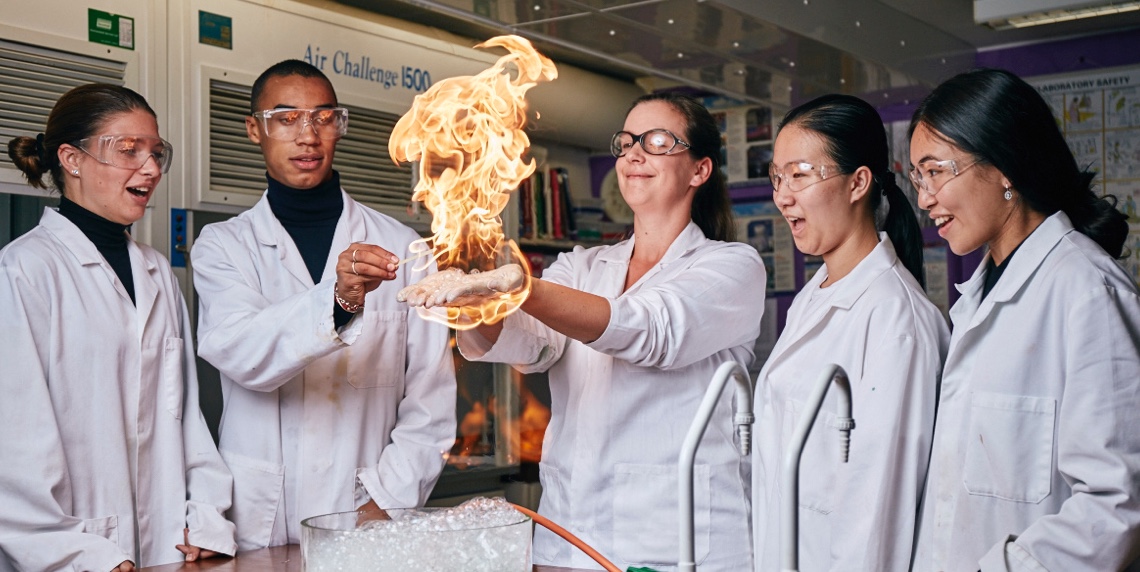
It is a misconception that Chemistry is just for scientists – it goes with any subject as a learning experience and a broad interest. Chemistry gives understanding of the important issues that face your generation. Can you really evaluate climate change, genetic engineering, food and agricultural additives without the safety of medicine? Would you like to discover something no-one else has ever seen or touched before? With Chemistry all this is possible and much more.

This knowledge and the analytical skills that you will develop will be an advantage in any career – banking, politics, medicine and law.

‘As far as we know, we are the only place in the universe where intelligent life has evolved and it is a privilege to live among such imaginative, creative and intelligent people’ – Carl Sagan.
 
These are very good reasons for you to study Chemistry. You are made of star dust! Millions of years ago, miles across the universe, a supernova exploded and the atoms cooked in this mega-pressure cooker were flung across the universe and eventually became planets like our Earth. Now we are able to study this amazing world and create all the things that improve the quality of life for us and all the creatures with which we share the planet.

How Chemistry is taught at Hurtwood House

At Hurtwood we follow the Salters Chemistry course. This was written and developed with funding of millions of pounds from many major companies. Each topic of the course was written with the combination of a university lecturer, an industrial expert and a teacher. Salters Chemistry has been accepted as one of the best, most popular and most exciting courses and is influencing teaching at school and university level.

At Hurtwood House you will be taught in small classes in a well-equipped new laboratory by highly-qualified staff. The lessons will revolve around practical work and the many fascinating uses of Chemistry in our lives. You will be able to learn the theory through experiments and develop the skills needed to achieve excellent exam results.

Every year our Chemistry students leave to study at some of the best universities in the country and the skills you will learn are essential training for university and many career opportunities that await.

Specifications

The Salters A-level Chemistry course is modular, ie examined in units. The Advanced Subsidiary (AS) comprises Units 1, 2 and 3 and the A-level (A2) comprises Units 1-6.
 
Unit 1: Chemistry for Life

Elements of life – The elements and compounds in the universe, iron in haemoglobin, calcium and osteoporosis in the human body.

Developing Fuels – A study of petrol and the contribution that chemists make to the development of better and alternative fuels.

Unit 2: Chemistry of Natural Resources

Elements from the sea – Extraction of halogens from the sea and their uses.
The atmosphere – Sunscreens, ozone holes, the greenhouse effect.
Polymer revolution –The development of polymers, their properties and uses.

Unit 3: Chemistry in Practice

Internal assessment of experimental skills (coursework).

Unit 4: Chemistry of Materials

What’s in a medicine? – A study of medicines, their development and testing, using instrumental analysis.
Materials Revolution – The chemistry of modern materials and their uses.
The thread of life – Proteins, enzymes, DNA and genetic fingerprinting.
Steel story – Steel and transition metals, redox reactions and batteries.

Unit 5: Chemistry by Design

Agriculture and Industry – Soil fertilizers, feeding the world, pesticides – good or bad?
Colour by Design – Paints, dyes, fabrics and how colours are produced.
The Oceans – World climate and weather, sea currents, controlling global warming.
Medicines by Design – The development of antibiotics and drugs to treat heart disease and asthma.

Unit 6: Individual Investigation

A practical investigation of your own choosing with assistance, suggestions and supervision.

What skills do I need?

GCSE (or Level 2 equivalent) in Maths, Chemistry or Science and Additional Science with grades A or B are required. 

After A-level

Chemistry is essential or strongly preferred for Medicine, Dentistry, Pharmacy, Biochemistry, Biology, Geology, Food Science, Nutrition, and Dietetics, as well as Chemistry, Chemical Engineering and Pharmaceutical Sciences. Today there are many joint degrees for Chemistry with Management, Law, Economics and Languages. Chemistry is highly regarded as a suitable A-level for university courses such as Law, Economics and Accountancy at the leading universities because a good grade proves you have well-developed logic and analytical skills as well as the ability to learn and understand complex material. You will also have a clear understanding of many current and topical issues.

Hurtwood provides excellent education in a positive living and learning environment

Marion SimÃce
Past student